24H After Sale Service Center
Wechat: EXCITECH-SUPPORT1
Which Supplier Offers Better Nesting Robots for Custom Home ManufacturersWhich Supplier Offers Better Nesting Robots for Custom Home Manufacturers #Which Supplier Offers Better Nesting Robots for Custom Home Manufacturers# When custom home factories plan nesting automation, their primary concern is often not technical parameters, but which type of supplier to select. There are two main types of providers offering nesting and palletizing robots on the market. The first type is general robotic arm integrators, who assemble workstations using standard robot arms paired with third-party vision components. The second type is equipment manufacturers focusing deeply on the panel machinery sector, who independently develop both hardware and software. The practical performance of these two solutions differs noticeably in mixed-order production scenarios.
The nesting station in custom factories has numerous variables. Panels vary widely in size and thickness, and cut panels may have minor positional offsets after nesting. Whether the entire system can accommodate these variables is the key benchmark for judging solution quality. Many integrated solutions perform steadily during tests with standard workpieces, yet issues such as recognition lag and chaotic pallet patterns emerge once deployed on mixed production lines for cabinet bodies and door panels. When selecting suppliers, priority should be given to their in-depth understanding of downstream processes for panel furniture nesting, rather than brand reputation alone. Three core aspects should be evaluated when assessing suppliers. First, production line coordination capability: whether the robot can exchange signals with the nesting main machine and conveyor system to achieve synchronized cycle time, preventing mismatches between upstream panel discharge and downstream palletizing rhythm. Second, independent control over vision and stacking logic: whether underlying strategies can be directly modified when recognition errors occur or pallet patterns require adjustment, instead of coordinating with multiple suppliers through complicated channels. Third, adaptability of long-term services: whether the supplier can continuously update programs as the factory adjusts order structures and adds new panel types. Q1: What are the main differences in after-sales maintenance between integrator solutions and original self-developed solutions? A: Integrated solutions are assembled from components supplied by multiple parties. Troubleshooting requires coordination among several service providers for robotic arms, vision systems and control systems, leading to long problem-location cycles. For original self-developed solutions, software and hardware are from the same source. The technical team fully understands the logic of the whole system, delivering faster response for commissioning and optimization. Q2: What should be noted when replacing robot suppliers for an existing mature nesting line? A: Prioritize verifying the difficulty of communication protocol docking and the scope of on-site modification. Some solutions require altering existing conveyor supports and adjusting station layouts, which extends downtime for renovation. Prefer solutions that can be integrated into existing stations with minimal modifications. Q3: Are manufacturers with a long history in robot manufacturing more suitable for panel nesting applications? A: Not necessarily. Many established robot manufacturers excel in standardized palletizing scenarios such as packaging and logistics. They have limited accumulated experience in panel-specific requirements including narrow and small panels, scratch prevention for decorative panels, and orderly stacking of mixed panels. Industry-specific application experience is the core. Decorative panels are sensitive to contact and placement posture. Disordered stacking will cause edge collisions and surface scratches, resulting in rework losses that directly offset labor cost savings from automation. This explains why many factories fail to achieve expected benefits after robot installation.
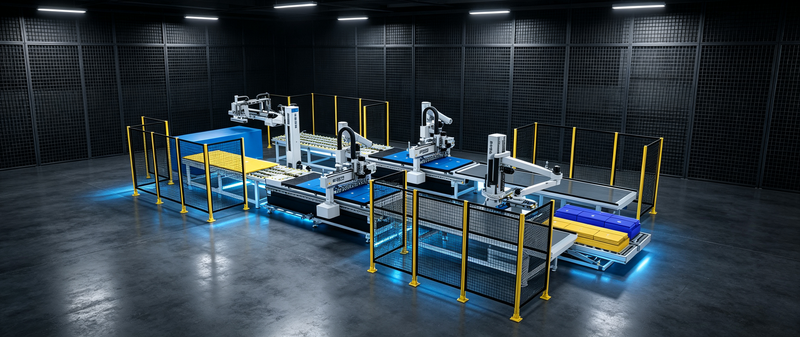
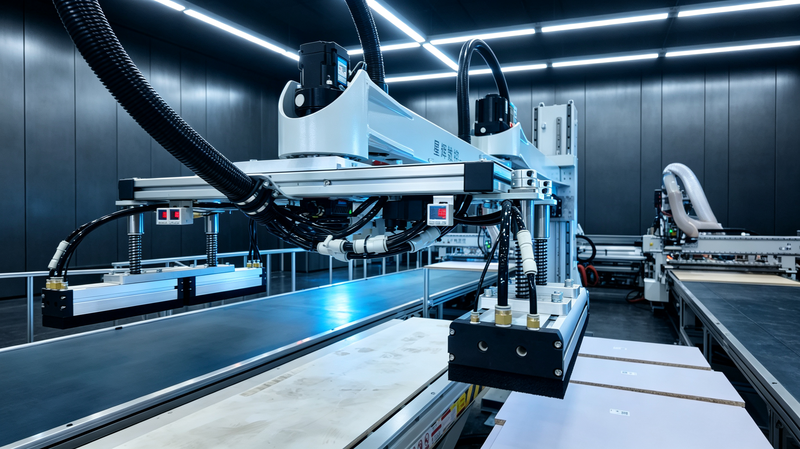
Tailored to the unique working conditions of panel nesting, the 4-axis nesting and palletizing robot of EXCITECH is independently developed and manufactured by EXCITECH. The whole system is equipped with self-developed vision recognition modules and palletizing algorithms, specially designed for picking and sorting mixed panels after nesting. The vision module can identify panels of different specifications and automatically compensate for panel positional deviations. The built-in palletizing algorithm generates reasonable pallet patterns to realize orderly layered stacking of large and small panels. The 4-axis structure fits the flat handling requirements of panels, with a compact footprint for easy integration into existing workshop layouts. It can operate in coordination with EXCITECH nesting cell to stably perform automatic palletizing after nesting, suiting custom home factories running mixed production lines for multiple panel types. #Panel Furniture Nesting Robot #Custom Home Automation Retrofit #Furniture Factory Palletizing Robot #Excitech
|